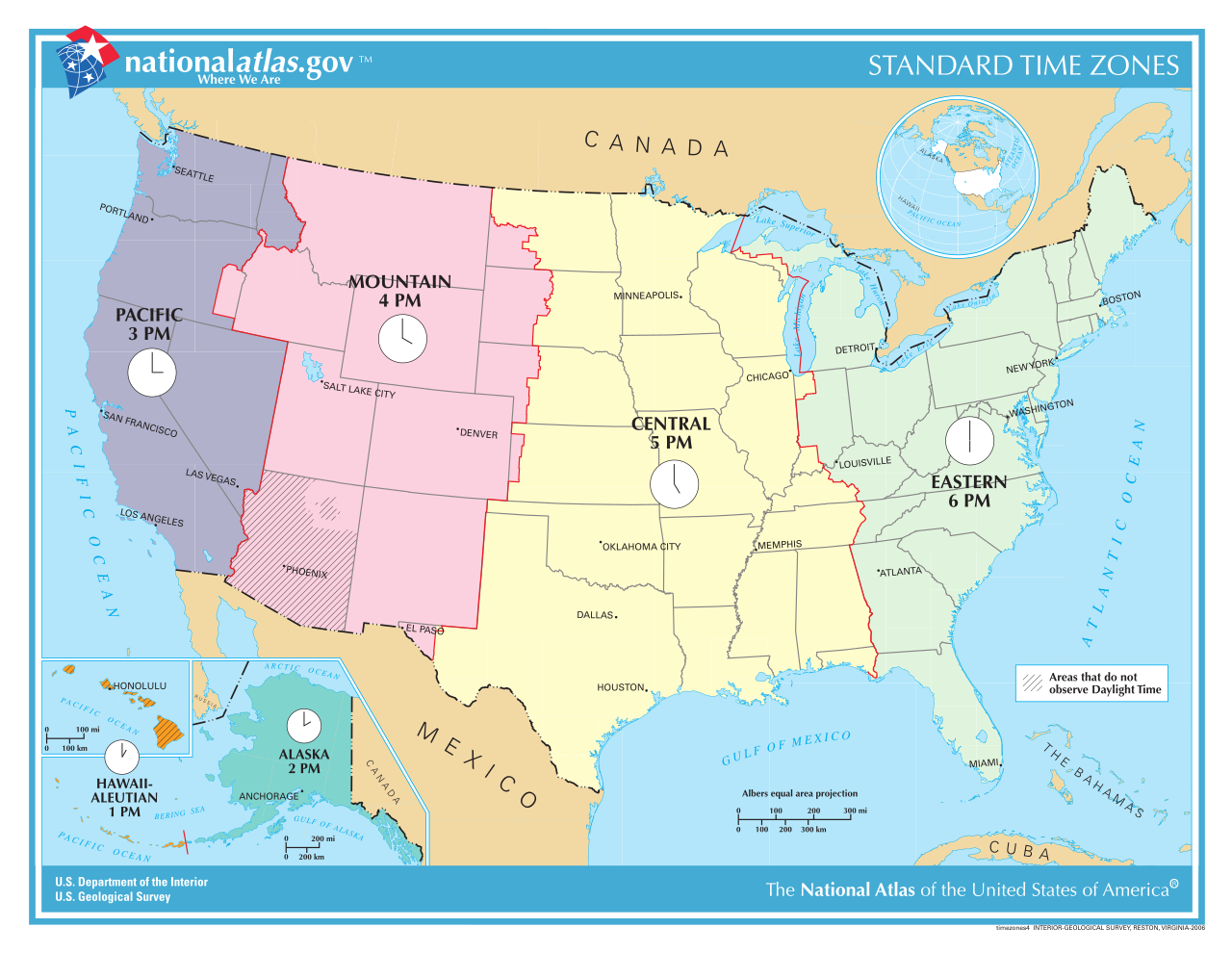
Imagine a country where noon in one major city means morning coffee in another, and evening rush hour in a third. This isn't a hypothetical scenario but the daily reality across the United States. Far from observing a singular clock, the concept of official time in America is a fascinating tapestry woven from geographical necessity, historical decisions, and seasonal adjustments. Understanding this intricate system is crucial for everything from business logistics to planning a cross-country phone call.
The Continental Divide: Unpacking the Four Primary US Time Zones
For those residing or doing business within the contiguous 48 states, the rhythm of life is dictated by four distinct time zones. These primary divisions ensure that the sun is roughly at its highest point around midday in each region, aligning daily schedules with natural light cycles.
- Eastern Time (ET): Encompassing much of the East Coast and several inland states, ET is often considered the baseline for many national broadcasts and financial markets. Major cities like New York City, Washington D.C., and Miami operate on Eastern Time.
- Central Time (CT): Moving westward, Central Time covers states like Illinois, Texas, and most of the Midwest. Chicago, Houston, and New Orleans fall within this zone, which is one hour behind ET.
- Mountain Time (MT): Spanning the Rocky Mountain states such as Colorado, Utah, and Montana, Mountain Time is two hours behind ET. Denver and Phoenix (with a unique caveat we'll discuss later) are key cities here.
- Pacific Time (PT): The furthest west of the contiguous zones, Pacific Time includes states along the West Coast like California, Oregon, and Washington. Los Angeles, San Francisco, and Seattle observe Pacific Time, which is three hours behind ET.
To put this into perspective, consider a national broadcast scheduled for 12:00 PM Eastern Time. For viewers in Chicago, it will air at 11:00 AM Central Time. In Denver, it's 10:00 AM Mountain Time, and those on the West Coast in Los Angeles will tune in at 9:00 AM Pacific Time. This cascading difference means that while New Yorkers might be enjoying lunch, Angelenos are still in the midst of their morning routines. The establishment of these zones dates back to the late 19th century, primarily driven by the need for standardized schedules for railway operations, which crisscrossed the burgeoning nation.
Beyond the Mainland: Alaska, Hawaii, and US Territories
While the four continental zones are the most commonly referenced, the United States' actual time zone count extends beyond this. If you factor in Alaska and Hawaii, the nation observes a total of six standard time zones. But the complexity doesn't stop there.
- Alaska Time (AKST/AKDT): Encompassing the vast majority of Alaska, this zone is four hours behind ET.
- Hawaii-Aleutian Time (HAST/HADT): Covering Hawaii and part of the Aleutian Islands, this zone is five hours behind ET. Notably, Hawaii does not observe Daylight Saving Time.
Furthermore, various US territories add even more layers to the national time landscape. Puerto Rico and the US Virgin Islands observe Atlantic Standard Time (AST), which is one hour ahead of ET. On the other side of the International Date Line, territories like Guam and the Northern Mariana Islands operate on Chamorro Standard Time (ChST), a staggering 14 hours ahead of ET. For those coordinating across these vast distances, understanding the nuances of the official time in each location becomes paramount, often requiring careful planning and sophisticated time zone converters.
Daylight Saving Time: Shifting Clocks and Arizona's Unique Rule
Adding another layer of complexity to America's timekeeping is Daylight Saving Time (DST). Most of the United States observes DST, a practice where clocks are adjusted forward by one hour in the spring and backward by one hour in the fall. The general rule is to "spring forward" on the second Sunday in March and "fall back" on the first Sunday in November. This adjustment is primarily intended to make better use of daylight, historically linked to energy conservation and agricultural benefits, though its actual impact is still debated.
However, not all states participate in this biannual ritual. The most prominent exception is the majority of Arizona. While the Navajo Nation within Arizona does observe DST, the rest of the state generally does not. This means that for a significant portion of the year, Arizona remains on Mountain Standard Time (MST) even as surrounding states shift to Mountain Daylight Time (MDT). This unique situation means that during DST, Arizona aligns with Pacific Daylight Time (PDT) rather than its geographic neighbors observing MDT. This can cause considerable confusion for travelers and those communicating across state lines.
Other non-DST observers include Hawaii (as mentioned), and the permanent US territories. For a deeper dive into the specifics of these changes and Arizona's fascinating exception, read our detailed article: US Daylight Saving Time: When Clocks Change and Arizona's Rule.
The Earth's Rotation: Why East is Always Ahead
The fundamental reason for these distinct time zones lies in the Earth's rotation. Our planet spins on its axis from west to east, completing a full rotation approximately every 24 hours. This rotation is why the sun appears to "rise" in the east and "set" in the west.
Consequently, regions further to the east experience sunrise, midday, and sunset earlier than regions to their west. This natural phenomenon is precisely why New York (Eastern Time) is three hours ahead of Los Angeles (Pacific Time). When the sun is directly overhead, signaling noon, in New York, the sun is still climbing towards its peak in Los Angeles, where it's only 9:00 AM. This consistent time differential means that for coast-to-coast operations, businesses must always account for this immutable law of physics. Planning a 9:00 AM PST meeting translates to a 12:00 PM EST start, a crucial detail for national teams.
For a comprehensive look at the astronomical reasons behind these differences and their impact on daily life, explore our related article: East vs. West: Why US Time Zones Differ by Hours.
Navigating America's Official Times: Practical Tips for Travelers and Businesses
Living and working in a country with multiple official time designations can present challenges, but with a few strategies, it’s easily manageable:
- Always Specify Time Zones: When scheduling meetings, flights, or events, always clarify the time zone. Instead of just "9 AM," use "9 AM ET" or "9 AM PT" to avoid ambiguity.
- Utilize Time Zone Converters: Numerous online tools and smartphone apps can quickly convert times between different zones, making cross-country communication effortless.
- Consider DST Impact: Remember that Daylight Saving Time can alter relative time differences for part of the year, especially when dealing with areas that don't observe it, like Arizona or Hawaii.
- Check Federal Agency Hours: If dealing with government agencies, be mindful of their local operating hours based on their specific time zone.
- Plan Travel Accordingly: When booking flights, especially those crossing multiple zones, be aware of "arrival time" vs. "departure time" in different local clocks.
The absence of a single official time across the United States is not a flaw in its system but a necessary adaptation to its vast geographical span. From the bustling East Coast to the serene Pacific, each region operates on a clock synchronized with the sun, ensuring practicality and order in a diverse nation.
In conclusion, the notion of a single official time in the United States is a myth. Instead, the nation embraces a dynamic system of multiple time zones, each carefully calibrated to geographical realities and occasionally adjusted for Daylight Saving Time. This intricate framework, while sometimes complex, is essential for maintaining order, facilitating commerce, and allowing every citizen to experience their day in harmony with the natural rhythm of light. Mastering the nuances of America's time zones is key to seamless communication, efficient travel, and successful nationwide coordination.